Bearded Dragon
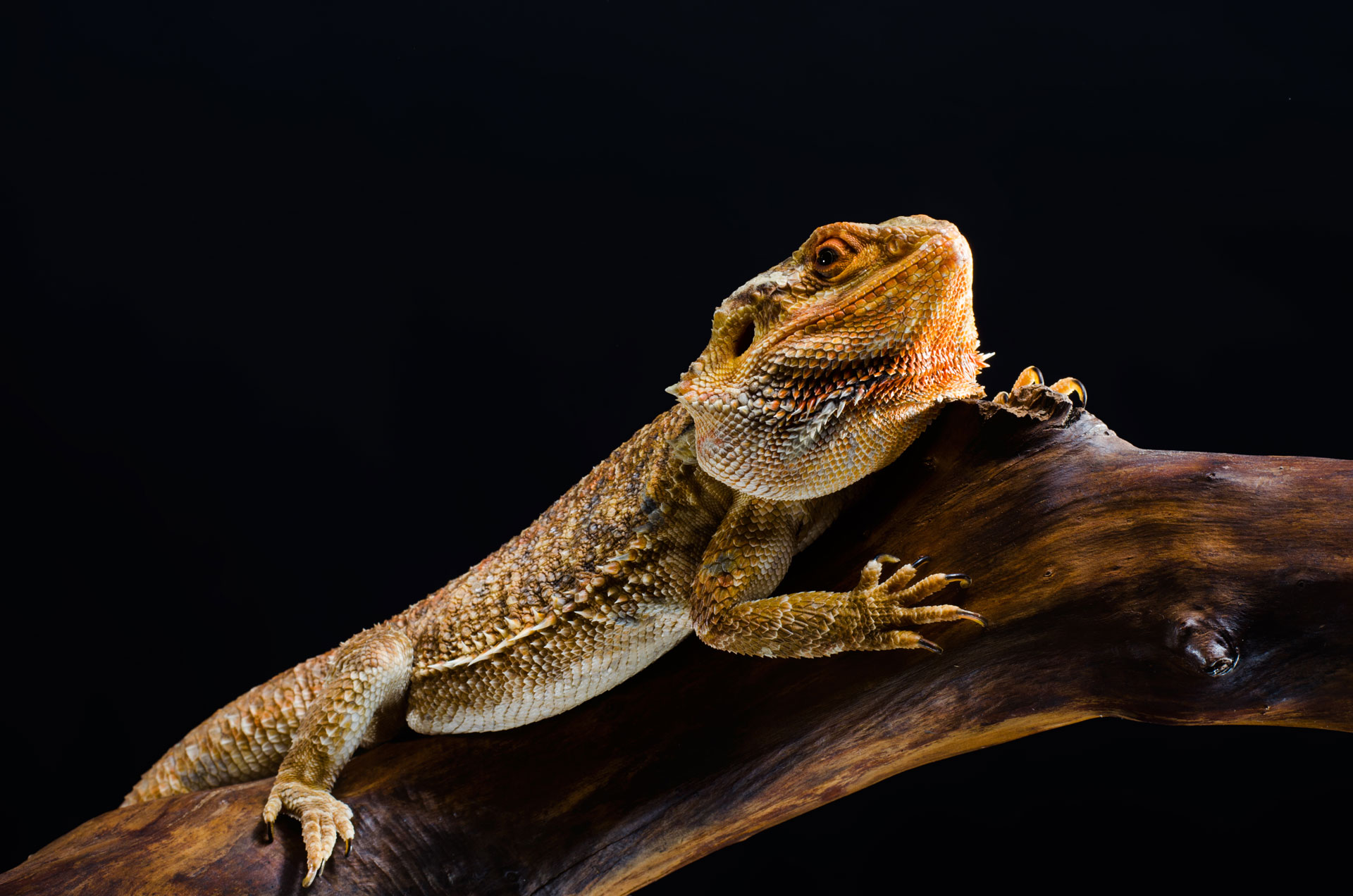
Common Name: Bearded Dragon
Scientific Name: Pogona vitticeps
Distribution: Australia
Size: 16-24″
Life Span: 5-15 years
Bearded Dragons are among the most popular pet reptiles in the hobby, for good reasons! Their interesting behaviors and docile nature make them excellent pets for any level reptile keeper, including first-time reptile hobbyists. All bearded dragons found in the US are captive-bred, and many different color morphs are becoming available.

Tank: A 40 gallon tank is the minimum size recommended for an adult bearded dragon. This Double Door terrarium provides easy access through front doors for feeding, cleaning, and other care. Glass terrariums are easy to clean, and do a good job of retaining heat, which is important for keeping bearded dragons.
Excavator Clay is used in this habitat to anchor wood décor in place and provide different basking levels. Excavator can also be used to make caves, or provide a solid substrate base if desired.
Substrate is the material that covers the bottom of the habitat. Bearded dragons are from arid regions and will do best on a substrate that helps re-create these conditions. Substrates help provide natural traction, which promotes natural bone and muscle development. Excavator clay creates the base in this terrarium and is topped with ReptiSand®. Loose substrate such as sand is simple to sift clean and helps provide a natural footing and aesthetic.
Branches: Strong, thick branches or other décor are used to provide basking sites and climbing opportunities. Although Bearded Dragons are considered terrestrial, they enjoy climbing to a sturdy, comfortable perch to overlook the terrain and soak up some sun. Items such as Mopani Wood provide a perfect basking site when placed below a heat lamp and UVB source.
Décor: Desert Flora and other items can be used to help create a naturalistic look. CAUTION: Bearded Dragons are omnivorous and eat plant material in nature- be sure that your pet understands that these are NOT edible by carefully observing behaviors. If your Bearded Dragon tries to eat non-food items, remove those items from the habitat immediately (and maybe feed your pet some more greens!)
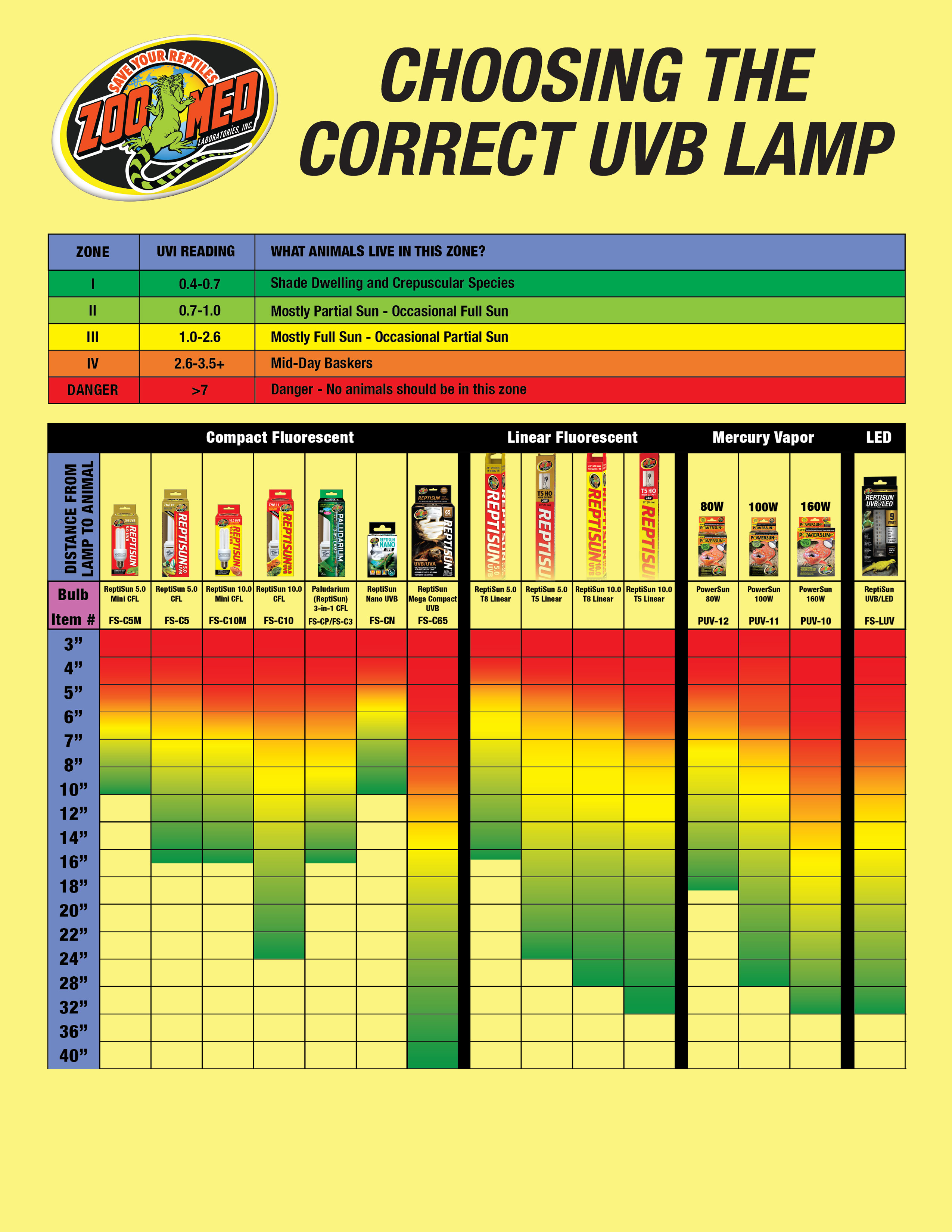
UVB Source: UVB is essential for the health and wellbeing of Bearded Dragons. Many different options are available depending on a variety of different factors. In this 40 gallon terrarium, there is a High Output T5 Hood and ReptiSun® 5.0 Lamp, because the distance from the basking site to the lamp itself is about ___ Inches. Use Zoo Med’s UVB guide to choose the correct lamp for your particular setup. Read more about UVB in our Lighting and UVB Education Pages
Heat Lamps: A variety of different heat lamps may be used to create the Preferred Optimum Temperature Zones for your Bearded Dragon. In this setup there is a Mini Combo Deep Dome that houses a ReptiTuff® for basking heat, and an Infrared Heat Projector for supplemental heat. The ReptiTuff® is a Halogen lamp that provides bright white visible light as well as excellent basking heat and can be used during daytime hours. The Infrared Heat Projector provides Infrared (heat) without any visible light so is appropriate for use any time- day or night.
Thermometers: Monitor basking and other terrarium temperatures throughout the habitat using at least one, but possibly several thermometers. The Min/Max Thermometer will record the highest and lowest temperatures measured so that keepers may know the how warm and cool the habitat is getting.
Thermometers: Monitor basking and other terrarium temperatures throughout the habitat using at least one, but possibly several thermometers. The Min/Max Thermometer will record the highest and lowest temperatures measured so that keepers may know the how warm and cool the habitat is getting.
Food Dish: Bearded Dragons should be offered all prepared diets, salads, and non-live foods on a clean dish that keeps it out of their substrate. Wash dishes regularly to keep the serving area clean for your pet!
Water Dish: Always provide a source of clean drinking water for your Bearded Dragon. The water dish should be placed away from any heat sources to keep it from getting too warm and evaporating too quickly. All tap water should be treated with Reptisafe® to remove chlorine and chloramines
Basking Site: Encourage your Bearded Dragon’s natural ability to thermoregulate or control its body temperature by providing a basking site and different temperature zones within the terrarium. A basking site is typically the hottest area of the habitat and is located right under a heat lamp. A sturdy branch provides a nice perch for your dragon to rest on while basking. Check out our Heating Education Page and guide to Thermoregulation to learn more.
Shaded: Just as dragons need to be able to bask, they need to be able to escape the light and heat as well. Provided a variety of different spaces within the terrarium including some with little to no light like a cave, hide, or other structure to allow animals to choose where they are most comfortable throughout the day.
Products Used in Bearded Dragon Setup
HABITAT
- Juveniles need, at minimum, a 20-gallon terrarium (30″ x 12″ x 12″).
- Adults need, at minimum, a 40-gallon terrarium (36″ x 18″ x 18″).
- Many keepers prefer terrariums with front-opening doors. Our front-opening, Double Door Naturalistic® Terrariums are available in 25-gallon and 40-gallon sizes.
- Provide plenty of hiding places on both the cool and warm sides of your habitat using Habba Huts and/or Natural Cork Rounds.
- Provide an elevated basking site that comfortably supports the animal’s entire body. Thick branches, rocks, Mopani Wood, and Cork Flats are excellent choices for climbing and basking. Sand-Blasted Grapevine is another great choice for juveniles but may be too thin for adults.
- Naturalistic Desert Flora can be the perfect finishing touch to your naturalistic habitat, but it should be added with supervision as bearded dragons are omnivores and may attempt to eat them.
HEATING
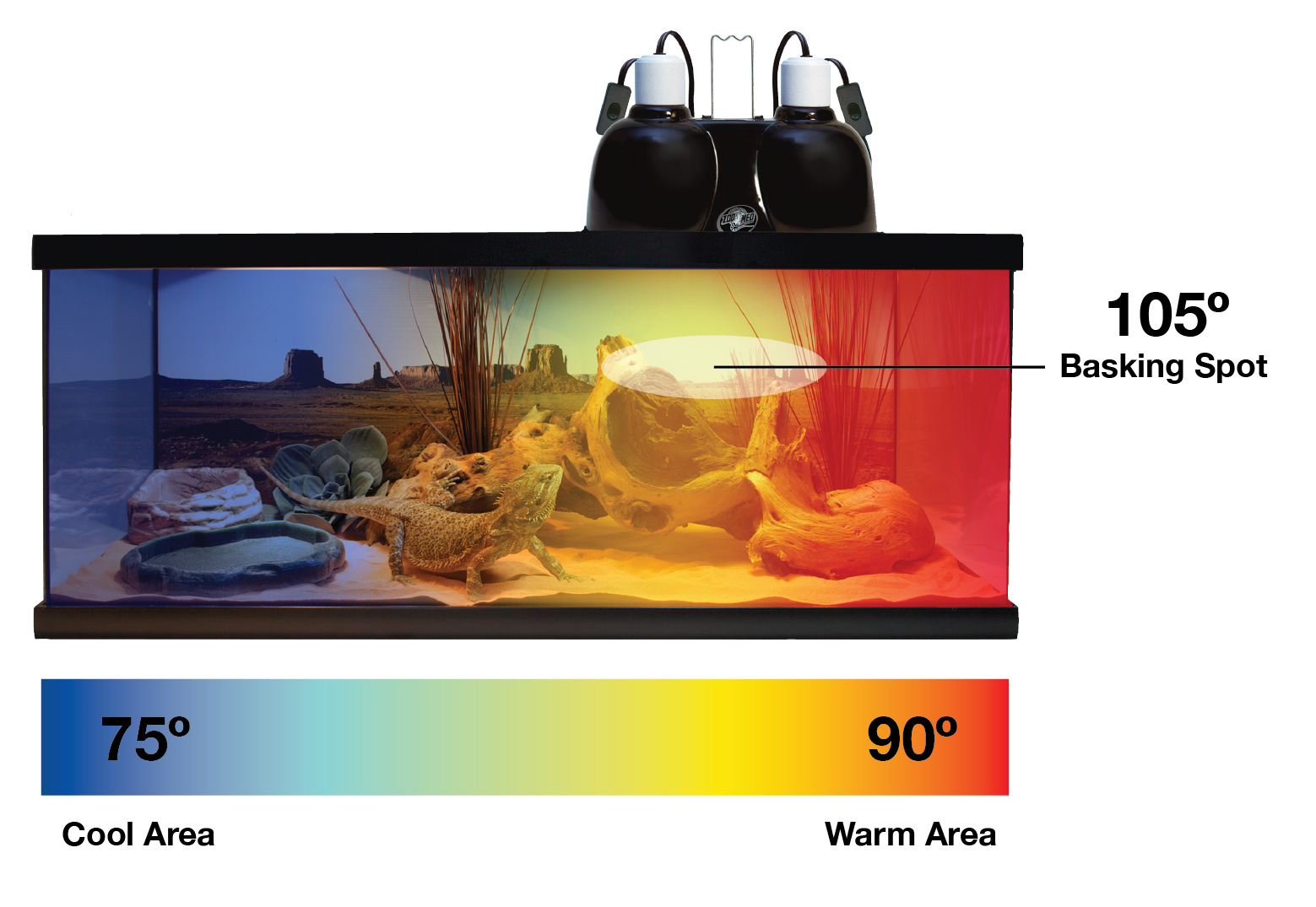
- Daytime Temperature: 75-90°F
- Basking Spot: 95-105°F
- Nighttime Temperature: 70-80°F
- A nighttime drop in temperature is natural, but the terrarium’s temperature should not dip below 70°F. In most cases, you will need to provide a 24-hour heat source that emits little or no visible light.
- Zoo Med’s Basking Spot Lamp, PowerSun®, and ReptiTuff Splashproof Halogen are good choices for basking and heating your enclosure during the day.
- Use the Min-Max Thermometer to view the current temperature and monitor temperature fluctuations.
- To help automate your enclosure and maintain precise temperatures, use the ReptiTemp® Digital Thermostat or the Environmental Control Center.
What is Thermoregulation?
It is necessary to establish a thermal gradient in your pet’s enclosure which includes a basking spot, warm area, and cool area. This will enable your pet to regulate its temperature by selecting the most suitable zone within the enclosure. The image depicts a well-constructed thermal gradient in a sample bearded dragon enclosure.
LIGHTING
- Reptiles have excellent color vision and can even see into the UVA spectrum, so it’s essential your habitat has adequate lighting.
- To replicate a natural day-night cycle, provide visible light for 10-12 hours during the daytime. UVB lamps provide visible light, including UVA.
- UVB lighting and heat are essential for bearded dragons in captivity to make vitamin D3 to process calcium, so they must be provided. Some reptiles can get adequate vitamin D3 from their diet, but this is not the case for bearded dragons. Without UVB lighting, bearded dragons will develop serious health problems like Metabolic Bone Disease (MBD).
- To determine the best UVB bulb for your set-up, consider the height of your enclosure, your animal’s Ferguson Zone, and the distance from the UVB light source to the basking area. Bearded Dragons are Ferguson Zone 4, Mid-Day Baskers, meaning their elevated basking site should have a UVI reading of 2.6 to 3.5+.
- Popular UVB sources for a 12” tall, 20-gallon juvenile enclosure are the ReptiSun® 10.0 Mini CFL, ReptiSun® 5.0 T5 Linear, and the 80W PowerSun® UV.
- Popular UVB sources for an 18” tall, 40-gallon enclosure are the ReptiSun® 10.0 CFL, ReptiSun® 10.0 T5 Linear, and the 100W PowerSun UV.
- Use our Lighting Guide to view UVI readings of our bulbs at different distances to help you choose the best bulb and determine the best basking site location for your set-up.
Learn more about visible light, UVB, and UVA:
SUBSTRATES
- Bearded dragons live in arid, sandy places in the wild and will do well on various sand-type substrates in captivity.
- Hatchling bearded dragons will do best on cage carpets.
- Excavator™ Clay Burrowing Substrate will allow you to create an enriching, naturalistic terrarium. You can keep it simple by layering it on the bottom of your enclosure or get creative by building burrows, tunnels, and securing decor items.
- ReptiSand® and ReptiFresh® are naturalistic and allow for natural digging behaviors.
NUTRITION
Bearded dragons are omnivores that eat both plants and insects at all stages of their lives but in different proportions as they age. Juveniles require a high-protein, insect-heavy diet, while adults require a high-fiber, plant-heavy diet. In the wild, bearded dragons have been observed to eat the soft leaves of plants, the hardy stems of grasses, and a variety of insects.
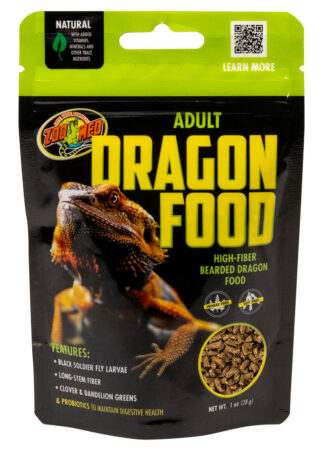
We recommend using a fortified commercial diet, like Dragon Food, to ensure your bearded dragon gets the appropriate nutrients for its life stage and to streamline your feeding routine. We also encourage providing live or canned insects and a variety of fresh greens and vegetables in the diet.

Insects
- Many insect options are available (crickets, roaches, worms, grubs, etc.). Dust with supplements (i.e., ReptiCalcium® & ReptiVite) before feeding and provide a variety when possible.
- Live insects are incredible for exercise and to stimulate natural hunting behaviors. Canned insects are shelf stable, making them easy to keep on hand. They can be tong fed and/or added to your dragon’s plate.
Vegetation
- Collard greens, dandelion leaves, endive/escarole, and romaine are several good options for leafy greens, while carrots, squash, green beans, and bell peppers are some of the choices for vegetables. Fruit should be limited to 5% of the diet, but mangos, blueberries, and bananas are beardie favorites.
- Thoroughly wash all produce before feeding to ensure it is clean of dirt, fertilizer, and pesticide residue. Then roughly chop it up for adults, but be sure to shred it into small pieces for juveniles. Sprinkle produce with supplements (i.e., ReptiCalcium® & ReptiVite) before feeding to fill nutritional gaps.
WATER
- Provide a clean water dish with fresh water at all times. Always treat tap water with ReptiSafe® Water Conditioner.
- Lightly misting the enclosure can encourage drinking and support hydration but is optional, especially in humid climates.
- A shallow bath can help hydrate your bearded dragon and promote healthy shedding. The Reptile Electrolyte Soak is an excellent addition to the water during a bath.
PRODUCTS AVAILABLE FOR THIS ANIMAL